
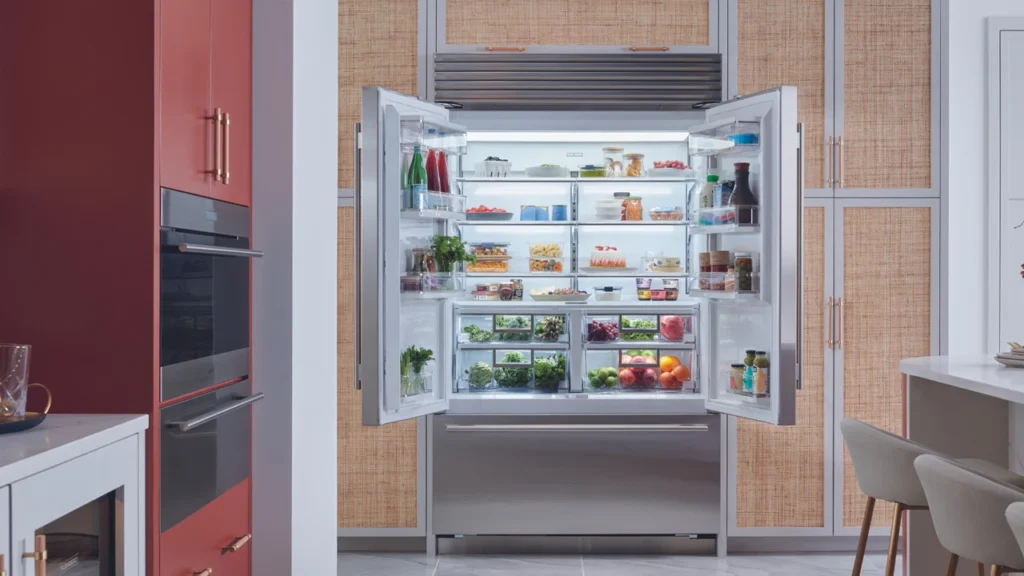
Why Sub-Zero Keeps Food Fresh Longer
Most people assume that food spoiling after a few days in the refrigerator is just normal. Berries go soft, leafy greens wilt, leftovers take on each other’s flavors. It feels inevitable.
It is not. The reality is that most conventional refrigerators are working against freshness in several fundamental ways, and the difference between a standard fridge and a Sub-Zero is not a matter of branding. It is a matter of engineering.
At BSC Culinary, we carry Sub-Zero and believe that understanding how this refrigeration actually works is the most honest way to explain why it justifies the investment. So let’s get into the science.
The Problem With Conventional Refrigerators
To understand what Sub-Zero does differently, it helps to first understand what most refrigerators do.
A typical household refrigerator uses a single compressor system. One cooling unit serves both the refrigerator and the freezer compartments. When the freezer kicks on, it sends cold, dry air into the refrigerator section. That dry air pulls moisture from your fruits, vegetables, and leafy greens, causing them to wilt and spoil faster than they should.
Because the air is shared between both compartments, odors transfer freely as well. The fish from last night ends up subtly influencing the flavor of your butter and milk. Every time the door opens, interior temperature rises and takes time to recover. All of these factors compound into food that does not last as long as it should.
Dual Refrigeration: The Most Important Difference
Sub-Zero pioneered a technology called dual refrigeration, and it is the single biggest reason their refrigerators preserve food more effectively than conventional units.
Instead of one compressor doing all the work, Sub-Zero uses two completely separate compressors and evaporators: one dedicated exclusively to the refrigerator section, and one dedicated exclusively to the freezer.
Here is what that separation actually produces:
In the refrigerator section, the environment stays cool and moist. Higher humidity is exactly what fruits, vegetables, and leafy greens need to stay crisp. Without a freezer system pulling dry air through the same space, produce holds its texture and freshness significantly longer.
In the freezer section, the environment stays cold and dry. This prevents frost buildup and freezer burn on meat and frozen items, because the freezer is no longer contending with the moisture demands of the refrigerator.
Odors and flavors stay separated. Because the two systems operate independently, there is no crossover of air between compartments. Your ice cream does not take on the flavor of last night’s leftovers.
The practical result of all of this is less food waste. The average American family throws away more than 103 pounds of food per year, roughly $3,000 annually. Better refrigeration is one of the most direct ways to change that number.
NASA-Inspired Air Purification
The second major technology in Sub-Zero refrigerators addresses a problem most homeowners have never thought about: ethylene gas.
Many fruits and vegetables naturally release ethylene as they ripen. This gas acts as a ripening signal, telling surrounding produce to ripen faster and, eventually, to spoil. In a conventional refrigerator, that ethylene simply accumulates, accelerating the deterioration of everything nearby.
Sub-Zero’s air purification system, developed using technology originally inspired by NASA, actively scrubs the interior air approximately every 20 minutes. It removes ethylene gas along with mold spores, bacteria, and odors on a continuous cycle.
The result is that your berries, avocados, and leafy greens stay fresh noticeably longer, not because of any passive feature, but because the system is actively working to extend freshness throughout every day of use.
Additional Engineering Worth Knowing About
Beyond dual refrigeration and air purification, several other design elements contribute to Sub-Zero’s performance:
Temperature precision. Sub-Zero maintains temperatures within one degree of the set point. Less fluctuation means food experiences fewer of the temperature swings that accelerate spoilage.
Superior insulation and build quality. Better insulation means the interior temperature recovers more quickly after the door opens, and holds more steadily throughout regular use.
High-humidity crisper drawers. Specifically designed to maintain the right moisture levels for produce, these drawers work in coordination with the dual refrigeration system rather than working against it.
Built to Last More Than 20 Years
Sub-Zero’s manufacturing process reflects the same commitment to longevity that defines their refrigeration technology.
Cabinets are formed on a Scott machine that bends galvanized stainless steel into precise dimensions. A coordinated measurement machine tests every unit’s height, width, depth, and critical point locations for dimensional accuracy. Each sealed system is tested using helium and nitrogen to verify that there are no leaks before the unit leaves the facility.
Sub-Zero products are designed, engineered, built, and tested to last over 20 years. For a refrigerator, which runs continuously every hour of every day, that level of engineering integrity matters more than in almost any other appliance category.
See Sub-Zero in Person at BSC Culinary
Understanding the technology is one thing. Seeing the construction quality and experiencing the difference in person is another.
At BSC Culinary, we have multiple Sub-Zero displays in our San Francisco showroom. If you are planning a kitchen upgrade and want to see and feel what separates Sub-Zero from conventional refrigeration, we invite you to stop by or schedule an appointment with our team. We are always happy to walk through the details and help you find the right configuration for your kitchen and your household.
Watch our video: The Science of Sub-Zero Refrigerators
BSC Culinary: Appliances that make every meal feel a little more special.