
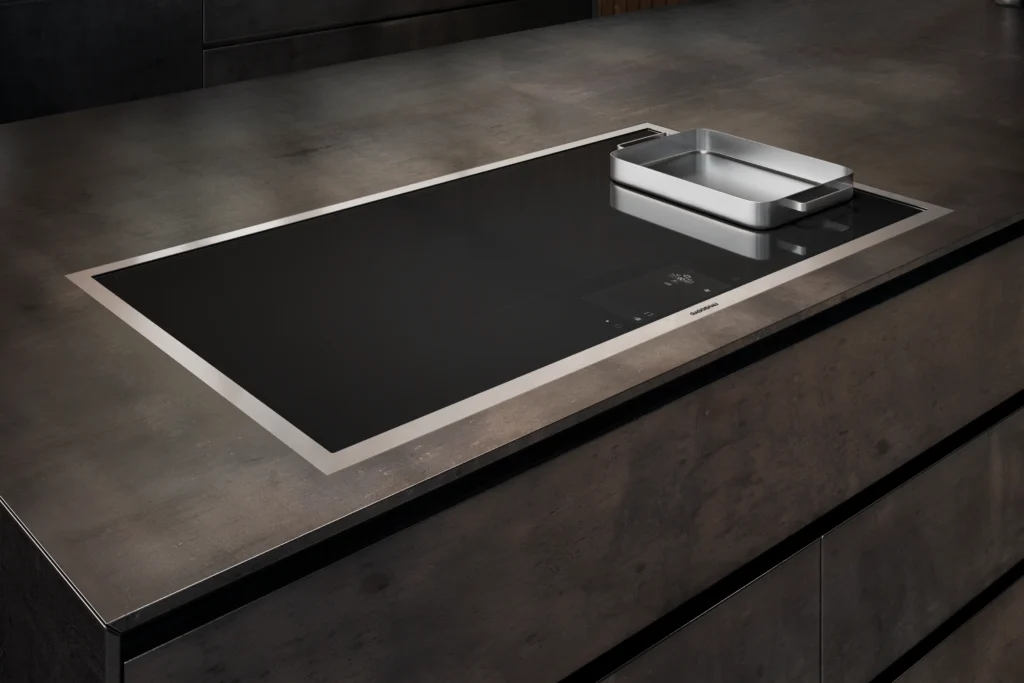
Most induction cooktops give you one piece of glass and whatever zones the manufacturer decided you get. You work around the grid instead of the other way around. A pan that’s slightly too big, a teppanyaki plate that doesn’t quite fit, a pot that lands half on and half off a burner — you learn to live with it.
Gaggenau built the Vario Series to remove that compromise entirely. Instead of a fixed layout, you get a cooktop that adapts to how you actually cook, not the other way around.
At BSC Culinary, we carry the full Vario lineup, and it’s one of the more interesting decisions a homeowner can make when planning a kitchen. Here’s a real look at what the 200 and 400 Series actually offer, and how they differ.
The Vario 200 Series: Flexible Zones, Reinvented Control
The 200 Series starts with the basics done right. It’s frameless and flush to the counter, so you get one clean plane of glass instead of a frame collecting crumbs and grease around the edges.
The real story here is the flex zones. Join two of them together and you can set down a bigger pan, a teppanyaki plate, or a griddle wherever it actually fits — then split them apart again for two smaller pots without starting over.
Control comes from a twist pad: twist to cook, lift it off when you’re done, and the glass wipes clean with nothing sitting on the surface to work around.
30-Inch Model
The 30-inch model gives you two flex zones at 7.5 by 9 inches each, which combine into a 15 by 9-inch stretch for oversized cookware, plus an 11-inch and a 6-inch round zone for everyday pots and pans. With 17 power levels, separate boosts for pots and skillets, a cooking sensor that holds pot temperature, and a frying sensor built for skillet work, it covers a real range of cooking styles. Settings include keep warm, timers, pot detection, residual heat indicators, child lock, and a safety shutoff — the practical stuff you’d expect at this level.
36-Inch Model
Same twist-pad technology and flush look, just more glass to work with. The flex pairs still join into long zones, but you also get a center ring that steps up in multiple levels and enough room that a 13-inch pot finally has somewhere to live without hanging off the edge.
24-Inch Model
If 30 or 36 inches is more than your kitchen needs, the 24-inch is built for smaller spaces — luxury apartments, condos, and ADUs come to mind. It has a more traditional feel with analog knobs instead of the twist pad, and it’s designed to combine with other Vario appliances in the Gaggenau lineup, including gas and teppanyaki, so you can build a full cooking suite even in a compact footprint.
The Vario 400 Series: When the Whole Cooktop Is the Cooking Zone
This is where Gaggenau does something genuinely different. There are no zones to obey on the 400 Series — the entire glass surface is the cooking surface.
Set down a 3-inch pot or a 13-by-21-inch tray, and the cooktop finds it and heats directly underneath, not under some painted ring that only sort of matches where your cookware actually sits. On the 30-inch model, you can run up to five pieces of cookware at once, positioned wherever makes sense for what you’re making.
Control comes through a color TFT screen on the front, with 17 power steps, timers, an information key, and pot detection. Larger cookware can pull up to 5.5 kilowatts. The cooktop itself has a 3-millimeter stainless steel frame and can be installed surface-mount with a visible edge, or flush into stone, solid surface, or wood — as long as the shop cuts the groove and handles the seal correctly.
Three Ways to Cook
What makes the 400 Series worth understanding is the three cooking modes, because they change how you actually interact with the surface:
- Classic — the mode most people already understand. Each pan holds its own power level, and you can put it anywhere on the glass.
- Professional — splits the surface into three heat bands running left to right: high, medium, low. Sear something on the hot third, then slide the pan over to cool it down without touching a single control.
- Dynamic — the same concept, but front to back. You manage temperature by moving the pan, not by tapping a screen.
There’s also a teppanyaki mode for the accessory plate, which treats part or all of the surface like a griddle, plus a cooking sensor for holding pot temperature, separate boosts for pots and pans, keep warm, and a pause button.
36-Inch Model
The same machine, just with more glass — same screen, same three modes, same teppanyaki function, same 5.5-kilowatt output on large cookware. The difference you actually feel is capacity: six pans instead of five, and more physical room to put those Professional and Dynamic modes to use.
36-Inch Flex Induction
If the touch-screen interface isn’t your style but you still want full-surface flexibility, Gaggenau offers a 400 Series variant with solid stainless steel control knobs instead. It combines with the rest of the Vario 400 lineup and keeps the same free positioning and flex function — just with an analog feel on the controls.
Which Vario Is Right for Your Kitchen?
If you like the idea of dedicated zones with the option to combine them, and you prefer the tactile click of the twist pad, the 200 Series is the more grounded choice — especially the 24-inch if you’re working with a smaller footprint.
If you cook for a crowd, rotate through a lot of cookware sizes, or just like the idea of never thinking about zones at all, the 400 Series is the bigger leap. It asks a little more of you to learn the three modes, but once it clicks, moving a pan to change its heat instead of reaching for a dial is hard to go back from.
Either way, you’re buying into Gaggenau’s reputation as an innovator with a real legacy in luxury kitchen appliances, not just a brand chasing a trend.
See Gaggenau in Person at BSC Culinary
Specs and flex-zone diagrams can only tell you so much. Twisting the pad, watching the 400 Series track a pan across the glass, feeling the weight of those stainless knobs — that’s the part you need to be standing in front of to really understand.
At BSC Culinary, we carry the Gaggenau Vario Series in our San Francisco showroom, and we’d love to walk you through which configuration actually fits your kitchen and your cooking style. If you’re planning a build or considering an upgrade, come see what full-surface induction feels like in person.
Watch our video: Are Gaggenau the Best Luxury Induction Cooktops?
BSC Culinary: Appliances that make every meal feel a little more special.